We’ve been doing these Deep Dive articles for a while now—delving into the history behind some of our favourite eyewear styles and trying to get to the bottom of why we like ‘em so much. Over the years we’ve talked about wraparounds, we’ve talked about aviators, we’ve talked about big ol’ oversized shades, but it recently dawned on us that we’d missed out one of the key pillars of spectacle style… square glasses. So here you go…
First things first, what are square glasses? Well… erm… that might sound like a stupid question, but the answer isn’t quite as clear as you’d maybe first think. Unless you’re still in nursery school, you’ve probably got a good idea what a square is—but to be honest when we talk about ‘square glasses’, the lenses are rarely—if ever—100% official, mathematically-correct, equal-sided squares. In fact, they should probably be called ‘rectangular glasses’—or if we’re being really pedantic, just ‘angular glasses’.

There’s another thing we should probably clear up here too—while today we often talk about square frames as ‘timeless’—it wasn’t actually that long ago that they were seen as radical symbols of the future. Back in the 19th century, glasses were small, dainty and round, maybe best described as the kind of spectacles that studious owls wear in Beatrix Potter illustrations, but by the dawn of the 20th century things were changing.
The Industrial Revolution and the rapid acceleration of technology ushered in a forward-facing attitude obsessed with the new. Movements like German Expressionism, Italian Futurism, Constructivism, Modernism, Art Deco and Surrealism all sprouted up to try and make sense of the speed, intensity and dynamism of the industrial city and where we were going next.
Architects were experimenting with reinforced concrete and stainless steel, while artists ditched realism and nice paintings of meadows in favour of abstraction and movement. This monumental vibe-shift could be seen in eyewear too—with opticians starting to boldly go beyond the omnipresent circle shape by introducing octagons, hexagons and squares into the equation.
That’s not to say the butcher, baker and candlestick maker were suddenly knocking about in boundary-pushing angular eyewear, but for the rare few at the bleeding edge of culture, these unique frames were the perfect way to flex your progressive, modernist tendencies.
Even well into the 1960s, square frames were a left-field choice reserved for those looking firmly forward. While the hippies mined the past to create their laid-back aesthetic, hiding their tired eyes behind the red-lenses of Victorian tea-shades, the mods lived up to their name with a wholly-modern uniform of luxury sportswear, sharp Italian suits, military surplus and chunky rectangular black acetate frames.
Michael Caine was a fan too—and the image of him and a pair of ever-so-slightly rounded rectangular frames in 1965’s The Ipcress File is still often regarded as the epitome of mid-century cool. Apparently his eyewear choice served another purpose beyond just looking slick too—with his distinct specs helping to give his character Harry Palmer an obvious point of difference from rival cinematic spy guy, James Bond.
While we’re talking ‘60s square specs we should probably mention Nico’s oversized sunglasses and whatever you call those super-slim shades the Byrds’ Roger McGuinn was partial to wearing (pictured below. George Harrison’s similar frames worn during the making of Revolver were a gift from McGuinn, if you wondered). Nico and McGuinn’s glasses might have been worlds apart, but they were both united in their radical nature—which is maybe why we like square frames so much…
Yep, they were big in the 70s (literally and metaphorically), and yes, they came back again in the 90s with a high-tech sheen, but to us—no matter how they’re served up, and what they’re referencing—square frames have always got a certain edge to them that’s great for when you want to add a bit of definition to your face.
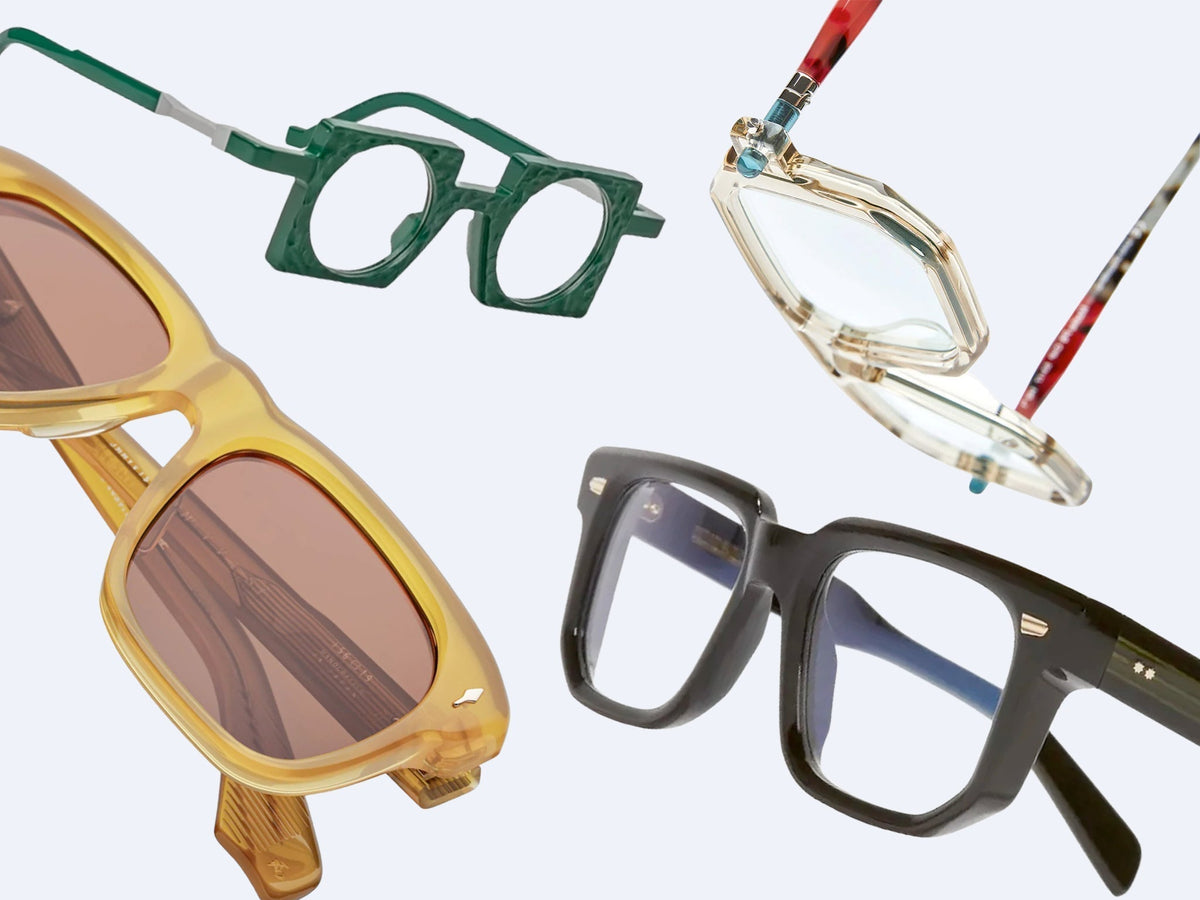
For the mathematical Modernists out there, Kuboraum and VAVA probably make the squarest frames we stock—with technicolour acetate and sharp angles giving designs like the Kuboraum P8 and the VAVA BL0038s a geometric flavour straight out of science fiction.

On the other end of the spectrum, the Jacques Marie Mage Yves or the Cutler and Gross 1410 Squares offer a perfect balance of strong lines and classic shapes for those who like their luxury a little more low-key.
Over a century after a few bold opticians decided to break down eyewear conventions and embrace the humble square, our favourite designers are still using sharp shapes to create designs that are as radical as they are wearable. Maybe Huey Lewis was right? When it comes to glasses, it's hip to be square… or oblong.
See our favourite square-framed glasses here.